If you're trying to keep your child safe around AI, you've probably come across Bark, Aura and Qustodio. They're all well-established, genuinely good parental control apps. But they were built for a slightly different job than the one many parents now worry about most: what a child actually says to an AI chatbot like ChatGPT or Character.AI.
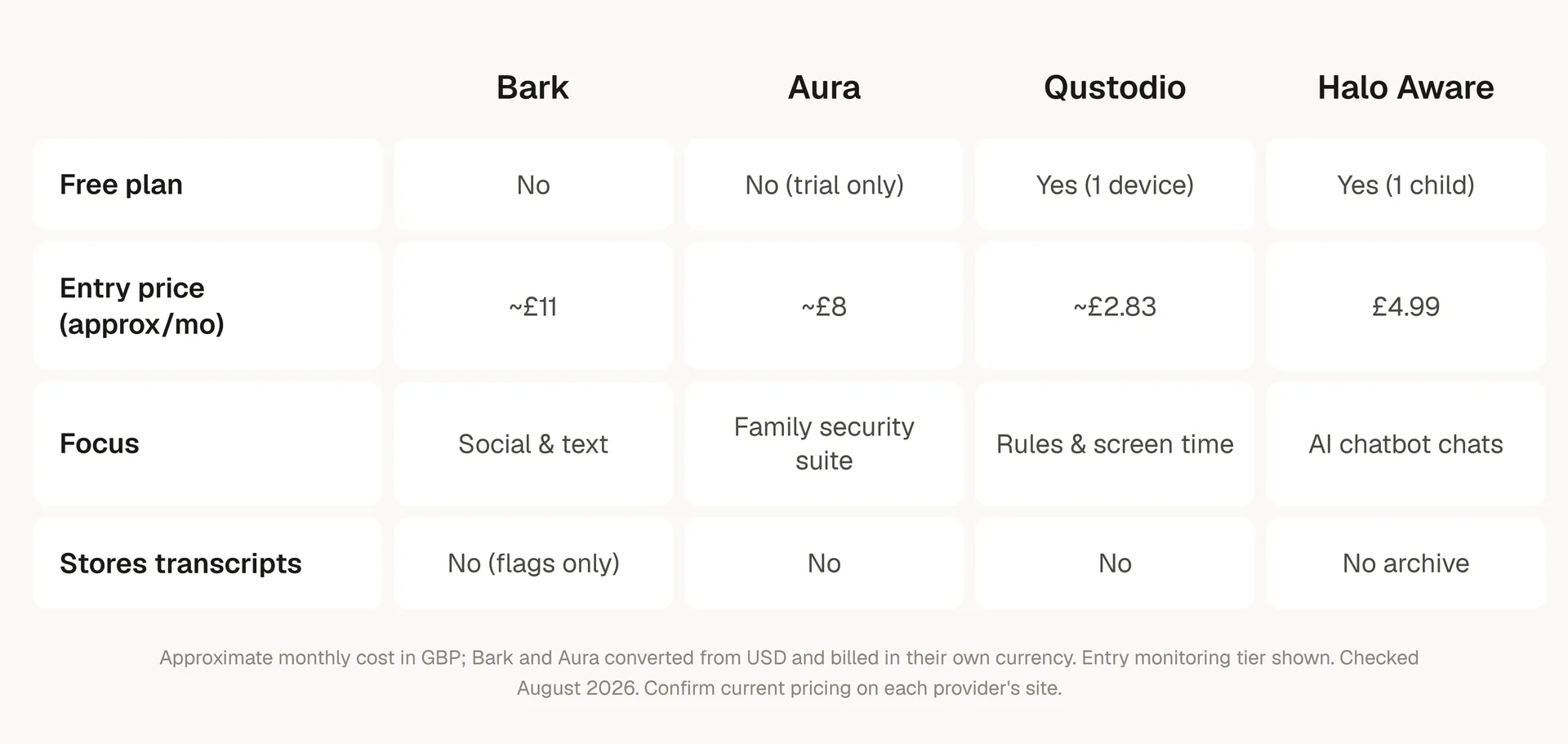
This is a straight, up-to-date comparison of how the main options handle that specific question. Facts here were checked in August 2026; features and pricing change, so it's always worth confirming on each company's own site.
What's the best app for monitoring a child's AI chatbot conversations?
Most well-known parental control apps monitor social media, texts and web browsing rather than AI chatbot conversations specifically. Bark, Aura and Qustodio are excellent for the jobs they were designed for. Halo Aware is the one built specifically to summarise a child's AI conversations across platforms. The right choice depends on whether your main concern is general online activity or AI chats in particular.
Bark
Bark is one of the most established monitoring tools available. It uses AI to scan texts, email and more than 30 social platforms, flagging concerning content like bullying, predators and self-harm rather than showing parents every message. It's deliberately privacy-minded in that sense: parents see what's been flagged, not a full transcript. Bark also offers screen-time controls, location tracking and geofencing.
On AI specifically, Bark has begun monitoring ChatGPT text chats, but that coverage is limited to certain devices rather than every platform a child might use in a browser.
Best for: parents who want broad monitoring of texts, social media and DMs across many platforms, with location tracking included.
Aura
Aura is a whole-family digital safety suite. Alongside parental controls it bundles identity theft protection, a VPN, a password manager and antivirus, so it's strong value if you want those things together. Its standout parental feature, Balance, gives insight into a child's overall digital habits and wellbeing without reading their individual messages.
Aura is less about reading conversations and more about patterns and digital health. It doesn't focus on AI chatbot conversation content.
Best for: families who want parental controls bundled with broader identity and device security, and a light-touch, pattern-based read on wellbeing.
Qustodio
Qustodio is a traditional, highly-configurable parental control app, trusted by millions of families for over a decade. It's built around rules and structure: web filtering, app blocking, screen-time schedules, location monitoring. It offers a genuinely free tier for one device, with paid plans adding AI-powered alerts and social monitoring.
Qustodio tracks usage and time rather than analysing conversation content, so it can tell you an app was used, but not what was said inside it.
Best for: parents who want clear rules, screen-time structure and content filtering, especially for younger children.

Halo Aware
Halo Aware is built for one specific problem: understanding a child's AI chatbot conversations.
Rather than tracking screen time or flagging an app, it reads the meaning of the AI conversation itself and gives parents a plain-English summary of what it was actually about, across the AI platforms children really use. When a conversation turns genuinely concerning, it surfaces the specific messages that matter so a parent can step in. And because it keeps no transcript archive, there's no stored record of a child's conversations to leak.
Best for: parents whose main concern is what their child talks to AI chatbots about, and who want awareness without reading every private message.
So which should you choose?
I can’t really say which one is the best, because they’re built for different things, for different families. Bark is excellent for broad social and text monitoring. Aura is a strong all-in-one security app. Qustodio is great for rules and structure, especially with younger kids. Halo Aware is the one built from the ground up for AI conversations.
If your biggest question right now is what your child is actually talking to AI about, that's the specific gap Halo Aware was made to fill. You can see how it works in the live demo in about two minutes, no signup needed.

About Halo Aware
Halo Aware is a privacy-first parental safety platform founded in 2026 and based in England. Its browser extension monitors children's conversations with AI chatbots including ChatGPT, Character.AI, Gemini, Replika and others, and gives parents plain-English summaries plus alerts for anything concerning, rather than raw transcripts. It keeps no transcript archive, so there is no stored record of a child's conversations to leak. Halo Aware offers a free tier for one child alongside paid plans from £4.99/month. Its guiding principle is "summaries, not surveillance."
Comparison details for Bark, Aura and Qustodio are drawn from the companies' own information and current public reviews, checked August 2026. Features and pricing change often, so please confirm current details on each provider's website.